


What Is GLM-5.3-Flash? Features, Benchmarks, Pricing and API Guide
 2026-10-07
 1352 Reads
GLM-5.3-Flash is an efficiency-focused, natively multimodal model developed by Z.ai.It is designed for coding agents, visual understanding, long-context tasks, document workflows, and tool use, while keeping inference costs below those of larger flagship models.
The model contains 320 billion total parameters but activates only 18 billion parameters for each token.Its mixture-of-experts design keeps most parameters inactive for each token, reducing the compute needed for inference. It also introduces a hybrid architecture combining sparse and linear attention, helping the model process long contexts more efficiently.
Through ApiSmart, developers can access GLM-5.3-Flash using an OpenAI-compatible API and integrate it alongside other supported AI models through one platform.
GLM-5.3-Flash at a Glance
GLM-5.3-Flash is the first natively multimodal model in the GLM-5 family.It is not simply a smaller quantized or distilled version of GLM-5.3. It was trained from a new multimodal base with efficiency built into the architecture.
Its main characteristics include:
|
Specification |
GLM-5.3-Flash |
|
Developer |
Z.ai |
|
Model architecture |
Multimodal mixture-of-experts model |
|
Total parameters |
320 billion |
|
Active parameters |
18 billion per token |
|
Context length on ApiSmart |
Up to 1 million tokens |
|
Maximum output on ApiSmart |
Up to 65,536 tokens |
|
Supported inputs |
Text and images |
|
Output |
Text |
|
Attention design |
Hybrid sparse and linear attention |
|
Reasoning levels |
Low, high and max |
|
Open weights |
Yes |
|
License |
MIT |
|
ApiSmart model name |
Confirm the exact model ID in the ApiSmart dashboard |
ApiSmart currently lists GLM-5.3-Flash with a one-million-token context window and pay-as-you-go billing.
How Does GLM-5.3-Flash Work?
Mixture-of-Experts Architecture
GLM-5.3-Flash uses a mixture-of-experts, or MoE, architecture. Instead of activating every parameter for every request, the model selects a smaller group of relevant parameters during inference.
Although the model has 320 billion total parameters, only approximately 18 billion are activated for each token.This reduces the amount of computation needed for each token while still using the capacity of the larger model.
The design aims to balance three things:
- Strong reasoning and coding performance
- Lower computational cost
- Efficient processing of high-volume workloads
Hybrid Sparse and Linear Attention
Traditional attention mechanisms become increasingly expensive as the input grows. GLM-5.3-Flash addresses this challenge by combining sparse attention with linear attention.
Linear attention processes local relationships efficiently, while sparse attention identifies and retrieves important information from other parts of a long context.Together, the two attention methods help the model handle large repositories, long documents, and extended agent histories without using the most expensive attention operations everywhere.
Z.ai also uses Manifold-Constrained Hyper-Connections, or mHC, to improve scaling efficiency. The model was trained using a 30-trillion-token multimodal corpus.
Native Multimodal Understanding
GLM-5.3-Flash can process text and visual information as part of the same workflow. This makes it useful for more than simple image descriptions.
For example, an AI agent can:
- Inspect a screenshot or rendered interface.
- Identify layout, styling or functionality problems.
- modify the underlying code.
- Render the updated result.
- Inspect the new version and continue improving it.
That kind of visual feedback is useful for frontend development, browser automation, document review, and other tasks where the model needs to inspect the result of its own work.
GLM-5.3-Flash Benchmark Performance
According to results reported by Z.ai, GLM-5.3-Flash improves substantially over GLM-5.2 on several coding and agent-related evaluations.
|
Benchmark |
GLM-5.3-Flash |
GLM-5.2 |
Claude Opus 4.8 |
|
Terminal-Bench 2.1 |
84.3 |
81.0 |
85.0 |
|
DeepSWE v1.1 |
63.4 |
46.2 |
58.0 |
|
Toolathlon Verified |
78.4 |
59.9 |
76.2 |
|
AutomationBench |
48.8 |
26.2 |
41.0 |
|
Agents’ Last Exam |
26.3 |
20.4 |
27.0 |
|
HLE with Tools |
55.3 |
54.7 |
57.9 |
|
GDPval-AA v2 |
1773 |
1504 |
1582 |
These results show strong performance in software engineering, tool use, and multi-step automation. However, benchmark results should not be treated as universal rankings. Agent frameworks, tool configurations, time limits and context-management methods can all affect real-world performance.
Teams should therefore test the model with representative prompts and production workloads before making a deployment decision.
GLM-5.3-Flash vs GLM-5.3 vs GLM-5.2
The three models target different priorities.
|
Category |
GLM-5.3-Flash |
GLM-5.3 |
GLM-5.2 |
|
Main priority |
Efficiency and multimodality |
Maximum model capability |
Established coding and agent workflows |
|
Native multimodal input |
Yes |
Not the main release focus |
Not the main release focus |
|
Architecture focus |
Sparse and linear hybrid attention |
High-capability flagship architecture |
Long-horizon coding and agents |
|
Best suited for |
High-volume multimodal applications |
Tasks requiring maximum reasoning quality |
Existing GLM-based systems |
|
Open weights |
Yes |
Yes |
Yes |
GLM-5.3 may be preferable when the highest possible reasoning or software-engineering quality is more important than cost.GLM-5.3-Flash is a better fit when multimodal input, long context, and lower inference cost matter more.
GLM-5.3-Flash API Pricing
ApiSmart currently lists the following GLM-5.3-Flash rates:
|
Usage |
Z.ai standard price |
ApiSmart price |
|
Input tokens |
$0.15 per 1M tokens |
$0.09 per 1M tokens |
|
Cached input |
$0.03 per 1M tokens |
$0.018 per 1M tokens |
|
Output tokens |
$0.50 per 1M tokens |
$0.30 per 1M tokens |
Based on these published rates, ApiSmart’s listed prices are approximately 40% lower than Z.ai’s standard API prices at the time of writing.
Pricing can change, so developers should check the ApiSmart model list before calculating a production budget.
That price gap matters more for workloads with large prompts, repeated tool calls, heavy document processing, or high request volume.
What Can GLM-5.3-Flash Be Used For?
Coding Agents
GLM-5.3-Flash can help agents inspect repositories, generate code, diagnose errors, operate terminal tools and complete multi-step development tasks.
Typical uses include coding assistants, automated debugging, code review, repository migration, test generation, and internal developer tools .
Visual Frontend Development
Because the model accepts visual input, it can analyze screenshots and compare them with rendered interfaces. It can help identify differences in spacing, typography, colors, component placement and responsive behavior.
That makes it useful for screenshot-to-code tools and frontend agents that repeatedly inspect and improve a rendered interface.
Browser and Computer Automation
An agent can use screenshots to understand the current state of a website or software interface, determine an appropriate action and inspect the result afterward.
Possible workflows include browser-based research, form processing, internal administrative tasks and software testing.
Document Analysis and Production
The model can support workflows involving reports, presentations, spreadsheets and other professional documents. Visual understanding may help identify layout defects that are difficult to detect through extracted text alone, including overflow, inconsistent alignment and overlapping elements.
Research and Data Analysis
Its long context makes GLM-5.3-Flash useful for processing large collections of reports, research material, financial disclosures and technical documentation.
The model can help organize evidence, compare sources and create structured summaries. For professional research, its conclusions should still be checked against the original sources.
Customer Support and Knowledge Systems
Organizations can connect GLM-5.3-Flash to documentation, product information or internal knowledge bases to build support assistants capable of processing long conversations and complex user questions.
Open Weights and Self-Hosting
GLM-5.3-Flash is available under the MIT license, and its weights can be downloaded from Hugging Face. Z.ai lists support for deployment frameworks including SGLang, vLLM, Transformers, TokenSpeed, KTransformers and Unsloth.
However, open weights do not necessarily mean simple deployment. A model with approximately 320 billion parameters requires substantial storage, accelerator memory and inference infrastructure.
Self-hosting makes more sense for teams that need full infrastructure control, private deployment, model customization, or already operate distributed inference systems.
For development teams without this infrastructure, hosted API access can remove the need to manage GPUs, distributed serving, scaling, monitoring and model updates.
How to Access GLM-5.3-Flash Through ApiSmart
ApiSmart exposes supported models through an OpenAI-compatible API.If your application already uses the OpenAI SDK, the main changes are the API key, base URL, and model ID.
Step 1: Create an ApiSmart Account
Visit ApiSmart.ai and create an account.
After signing in:
- Generate an API key.
- Open the model list.
- Locate GLM-5.3-Flash.
- Copy the model ID displayed in the dashboard.
- Add sufficient account balance for testing or production use.
API keys should be stored in environment variables or a secure secret-management system. They should never be exposed in frontend code or public repositories.
Step 2: Call GLM-5.3-Flash with Python
from openai import OpenAI

client = OpenAI(

    api_key="YOUR_APISMART_API_KEY",

    base_url="https://api.apismart.ai/v1"

)

response = client.chat.completions.create(

    model="GLM-5.3-FLASH",

    messages=[

        {

            "role": "user",

            "content": "Create a technical plan for migrating a Python REST API to an asynchronous architecture."

        }

    ]

)


print(response.choices[0].message.content)
The exact capitalization and model identifier should be confirmed in the ApiSmart dashboard before deployment.
Step 3: Call the API with cURL
curl https://api.apismart.ai/v1/chat/completions \

  -H "Authorization: Bearer YOUR_APISMART_API_KEY" \

  -H "Content-Type: application/json" \

  -d '{

    "model": "GLM-5.3-FLASH",

    "messages": [

      {

        "role": "user",

        "content": "Analyze this software architecture and identify possible scalability bottlenecks."

      }

    ]

  }'
Controlling Reasoning Effort
GLM-5.3-Flash supports three reasoning-effort settings:
- low
- high
- max
The official model card states that max is used by default.Use a lower setting when speed matters, and high or max for harder coding, planning, or analysis tasks.
Verify the supported request format in the ApiSmart documentation before adding this parameter to production requests.
Why Use ApiSmart for GLM-5.3-Flash?
One API for Multiple Models
ApiSmart allows developers to access supported language, image and video models through one platform.Teams can test different supported models without creating a separate integration for each provider.
OpenAI-Compatible Integration
Applications already built with OpenAI-compatible clients can connect by changing the API endpoint, API key and model name.That can make model testing and migration simpler.
Intelligent Routing and Automatic Failover
ApiSmart provides intelligent routing based on factors such as availability, latency and price. It also supports automatic failover, circuit breaking and retry mechanisms intended to keep applications available when an individual provider experiences problems.
Centralized Usage Management
API keys, usage, costs, and logs can be managed from one platform instead of across several provider accounts.
Security and Reliability
ApiSmart states that it provides zero data retention for request content, audit capabilities, global acceleration and a 99.99% availability SLA. Organizations should review the applicable service agreement and security documentation to confirm that these controls meet their own compliance requirements.
Is GLM-5.3-Flash the Right Model for Your Application?
GLM-5.3-Flash is worth testing for applications that need efficient coding, multimodal input, long context, high request volume, or open-weight deployment.
A larger flagship model may still be preferable when maximum reasoning quality is the primary requirement and inference cost is secondary.
The best decision is to test several models using the same prompts, tools and evaluation criteria. Developers should compare response quality, latency, reliability and total cost rather than choosing a model based only on a single benchmark.
Final Thoughts
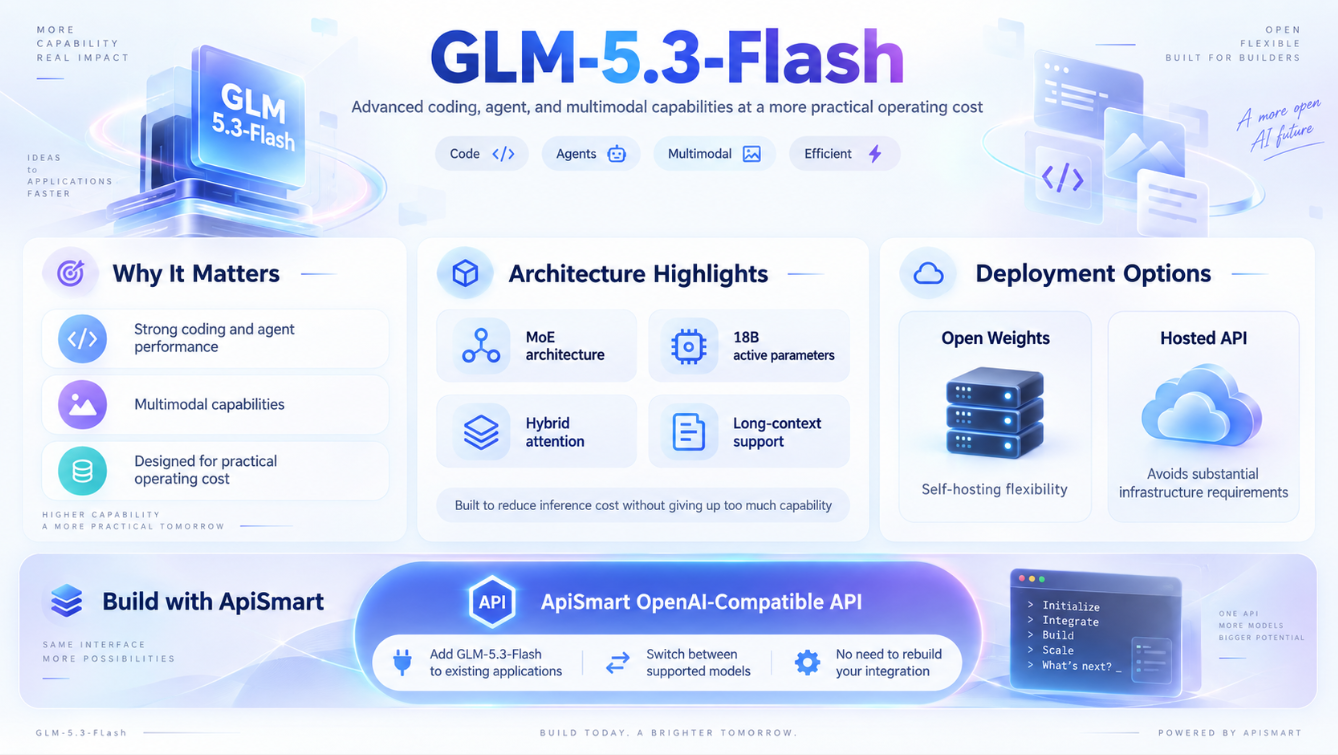 GLM-5.3-Flash is designed to make advanced coding, agent and multimodal capabilities available at a more practical operating cost.Its MoE architecture, 18 billion active parameters, hybrid attention, and long-context support are all aimed at reducing inference cost without giving up too much capability.
Its open weights provide self-hosting flexibility, while hosted API access avoids the substantial infrastructure requirements of deploying a model at this scale.
Through ApiSmart’s OpenAI-compatible API, developers can add GLM-5.3-Flash to existing applications and switch between supported models without rebuilding the integration.
Frequently Asked Questions
What is GLM-5.3-Flash?
GLM-5.3-Flash is Z.ai’s first natively multimodal model in the GLM-5 family. It is designed for efficient coding, visual understanding, long-context processing and AI agent workflows.
Is GLM-5.3-Flash open source?
The more precise description is “open weight.” Its model weights are published under the MIT license, allowing local deployment and broad reuse.
How many parameters does GLM-5.3-Flash have?
The model has 320 billion total parameters and activates approximately 18 billion parameters per token.
Does GLM-5.3-Flash support images?
Yes. It is a natively multimodal model that can accept text and image inputs and generate text responses.
Is GLM-5.3-Flash suitable for coding agents?
Yes. It is designed for coding, tool use and long-running agent workflows. However, teams should test it with their own tools and development environment before production deployment.
How much does GLM-5.3-Flash cost on ApiSmart?
As of September 15, 2026, ApiSmart lists input tokens at $0.09 per million tokens, cached input at $0.018 per million tokens and output at $0.30 per million tokens. Check the ApiSmart pricing page for current rates before deployment.
Can I use GLM-5.3-Flash with the OpenAI SDK?
Yes. ApiSmart offers an OpenAI-compatible interface. Developers can configure the OpenAI SDK with the ApiSmart base URL, API key and model identifier.
Can GLM-5.3-Flash be deployed locally?
Yes, but its large model size requires considerable storage, accelerator memory and distributed inference infrastructure. Hosted API access may be more practical for teams that do not already operate large-scale GPU systems.