


DeepSeek-V4-Flash vs GLM-5.3-Flash: Which Model Should You Choose?
 2026-10-07
 1395 Reads
DeepSeek-V4-Flash and GLM-5.3-Flash approach the “Flash” model category from different directions.
DeepSeek-V4-Flash concentrates on efficient text processing, coding, long-context reasoning and high-volume generation. GLM-5.3-Flash expands the same efficiency-oriented concept into multimodal and agent-driven workflows involving images, video, documents and external tools.
The choice is not just about which model scores higher on benchmarks. It depends on what enters your application, what the model must do with that input and how quickly the workload needs to scale.
The short answer is:
- Choose DeepSeek-V4-Flash for high-throughput text generation, code processing and long-running text agents.
- Choose GLM-5.3-Flash for multimodal applications, visual coding, document analysis and complex tool-based automation.
- Test both when coding quality, reasoning, latency, and cost all matter.
ApiSmart lets developers test supported models through the same OpenAI-compatible API instead of building a separate integration for each provider.
DeepSeek-V4-Flash vs GLM-5.3-Flash at a Glance
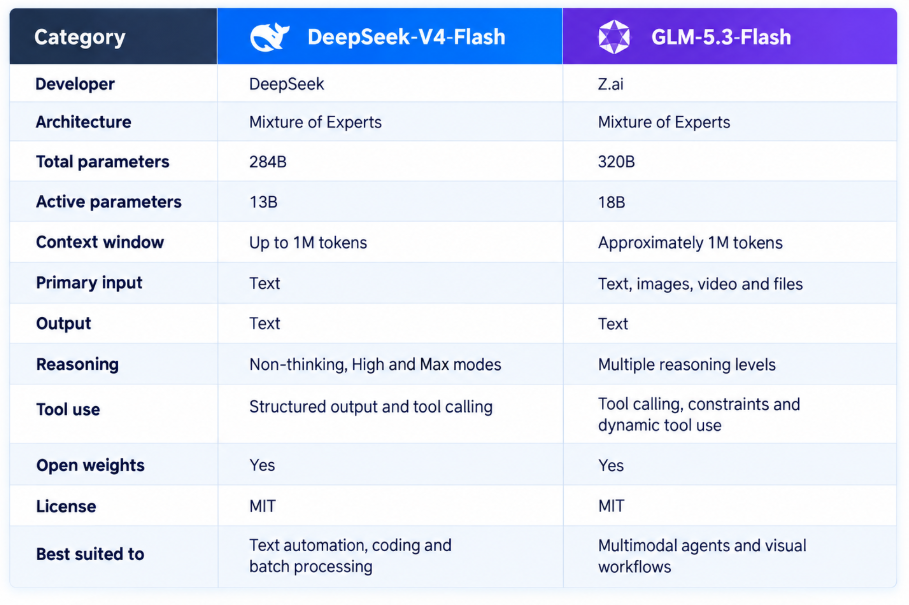
DeepSeek’s official model card describes DeepSeek-V4-Flash as a 284-billion-parameter MoE model that activates 13 billion parameters per token and supports a one-million-token context window. It also documents three reasoning configurations: Non-think, Think High and Think Max.
The specifications in this table describe the models themselves. Context limits, supported input formats, parameters and availability on a hosted API may differ from self-hosted releases.
What Is DeepSeek-V4-Flash?
DeepSeek-V4-Flash is the smaller, efficiency-focused model in the DeepSeek-V4 family. Its architecture contains 284 billion total parameters but activates only 13 billion for each token.
That sparse design can reduce the amount of compute needed for each token.The model keeps the capacity of a large network while activating only part of it during inference.
DeepSeek states that the V4 series was trained on more than 32 trillion tokens and uses a hybrid attention architecture designed to reduce the computational and memory cost of processing very long contexts. The official release supports a context length of up to one million tokens.
Core strengths of DeepSeek-V4-Flash
Long-context text processing
A one-million-token context can accommodate large repositories, technical documentation, research collections, and long conversation histories. Applications still need sensible retrieval and context management, but the larger window reduces the need to divide every task into small, isolated prompts.
Flexible reasoning depth
Developers do not always need the model’s maximum reasoning effort. Routine extraction or formatting tasks should not consume the same inference budget as repository-level debugging or multi-step planning.
Its reasoning modes let developers choose between faster responses and deeper analysis depending on the task.
Coding and structured workflows
The model is designed for code generation, technical analysis and agent workflows. It can be used for tasks such as:
- Reviewing large codebases
- Generating or refactoring code
- Producing structured responses
- Executing tool-based development workflows
- Processing technical documents
- Automating repetitive text operations
Efficient sparse inference
Activating 13B parameters out of 284B gives DeepSeek-V4-Flash a relatively lean inference path for a model of its overall scale.That can be useful for applications that care about throughput as much as peak reasoning quality.
DeepSeek-V4-Flash limitations
The standard DeepSeek-V4-Flash model is primarily text-oriented. If an application needs to inspect screenshots, diagrams, videos or visually complex documents, it may require a separate vision model or an additional preprocessing stage.
Its large model weights also mean that “open weights” should not be confused with easy local deployment. Operating the complete model still requires substantial memory, storage and inference infrastructure.
What Is GLM-5.3-Flash?
GLM-5.3-Flash is a multimodal MoE model designed for agent execution, long-context processing and workflows that combine language with visual or document inputs.
The bigger difference is not its parameter count, but the types of input it can handle. GLM-5.3-Flash is intended to accept multiple input types within the same workflow.That lets developers build visual workflows without adding a separate vision model.
Core strengths of GLM-5.3-Flash
Native multimodal understanding
GLM-5.3-Flash is a better fit when the task depends on images, screenshots, video frames, or visual documents.
Potential applications include:
- Reviewing a rendered web interface
- Extracting information from visual reports
- Understanding charts and diagrams
- Analyzing screenshots during software testing
- Processing mixed text-and-image documents
- Building visual browser agents
Agent-oriented execution
Complex agents must do more than produce fluent text. They must interpret instructions, select tools, preserve state and recover when an intermediate action fails.
GLM-5.3-Flash is positioned for these multi-step workflows, particularly when tool use must interact with visual information or structured files.
Long-context multimodal workflows
The long context becomes more useful when code, documentation, task history, and visual references all need to stay in the same workflow. This makes GLM-5.3-Flash relevant to repository agents, document assistants and visual development systems.
Efficient attention design
The model uses an attention architecture intended to reduce the memory cost of long-context inference. That can improve the feasibility of processing large prompts and supporting concurrent workloads, although real performance still depends on the serving infrastructure.
GLM-5.3-Flash limitations
Multimodal support does not automatically make GLM-5.3-Flash better for every workload.
A text-only application may not benefit from the added architecture. For large-scale content processing, code completion or deterministic text transformation, DeepSeek-V4-Flash may deliver a more focused performance profile.
Self-hosting GLM-5.3-Flash also remains a demanding infrastructure project because the full model contains hundreds of billions of parameters.
Architecture and Parameter Efficiency
Both models use Mixture-of-Experts architectures. Instead of activating the entire network for every token, the model routes each token through a smaller selection of experts.
|
Architecture metric |
DeepSeek-V4-Flash |
GLM-5.3-Flash |
|
Total parameters |
284B |
320B |
|
Active parameters per token |
13B |
18B |
|
Active share |
About 4.6% |
About 5.6% |
|
Context capacity |
About 1M tokens |
About 1M tokens |
DeepSeek-V4-Flash activates fewer parameters per token, which supports its emphasis on efficient text generation. GLM-5.3-Flash uses a larger active path to support more general agent and multimodal capabilities.
Parameter counts alone do not determine application quality.Training, post-training, quantization, inference settings, and serving infrastructure can matter just as much in practice .
Text Generation and Coding
DeepSeek-V4-Flash fits workloads that are mostly text or source code.
Examples include:
- Repository summarization
- Code completion
- Automated documentation
- Data extraction
- Log analysis
- SQL generation
- Large-scale content transformation
- Multi-turn coding assistants
Its text-first design and smaller active path can be useful for applications handling many requests or long outputs.
GLM-5.3-Flash is also capable of coding, but its advantage becomes clearer when code must be evaluated against visual output. A frontend agent, for example, may generate a page, inspect the rendered screenshot and then correct layout problems based on what it sees.
For pure text coding loops, DeepSeek-V4-Flash may be the more focused choice. For visual-in-the-loop development, GLM-5.3-Flash has the broader toolset.
Multimodal Capabilities
This is the clearest distinction between the two models.
DeepSeek-V4-Flash’s standard release is built around text input and output. GLM-5.3-Flash supports multimodal input, allowing applications to incorporate images, video and documents into the reasoning process.
|
Workflow |
Better starting point |
|
Text summarization |
DeepSeek-V4-Flash |
|
Code generation |
DeepSeek-V4-Flash |
|
Large batch text processing |
DeepSeek-V4-Flash |
|
Screenshot analysis |
GLM-5.3-Flash |
|
Visual interface debugging |
GLM-5.3-Flash |
|
Mixed document processing |
GLM-5.3-Flash |
|
Multimodal browser agent |
GLM-5.3-Flash |
|
Image-assisted automation |
GLM-5.3-Flash |
If visual input is central to the product, GLM-5.3-Flash is the more natural fit . If the workflow is entirely text-based, multimodal support should not be treated as an automatic advantage.
Long-Context Performance
Both models support context windows near one million tokens, but long context should be evaluated carefully.
A large advertised context window does not guarantee that a model will use every part of a long prompt with equal accuracy. Developers should test:
- Retrieval accuracy at different prompt positions
- Instruction retention over long conversations
- Latency as context size increases
- Input-token cost
- Tool-call reliability
- Output consistency
- Performance under concurrent requests
For software development, it is rarely efficient to send an entire repository on every request. Retrieval, caching and repository maps can still reduce latency and cost even when the selected model supports a one-million-token context.
Reasoning and Agent Workflows
DeepSeek-V4-Flash offers selectable reasoning depth. Routine requests can use a faster mode, while difficult planning or coding problems can be assigned a larger reasoning budget.
That matters when the same application handles both simple and complex tasks. A simple classifier, for example, should not be configured like an autonomous coding agent.
GLM-5.3-Flash becomes more useful when an agent needs to reason over images or documents. Examples include:
- Browser automation
- Visual quality assurance
- Document review
- Interface testing
- Workflow orchestration
- Multimodal research assistants
The better model for your application still needs to be tested with real tasks. Agent reliability depends on prompts, available tools, validation logic and recovery mechanisms—not just the base model.
Benchmark Results: How Much Should They Matter?
Published benchmark comparisons often show GLM-5.3-Flash ahead in several agent and software-engineering evaluations, while DeepSeek-V4-Flash remains competitive and emphasizes efficient generation.
Benchmarks are useful for narrowing the options, but they do not guarantee production performance.
Benchmark outcomes can change according to:
- Model version
- Reasoning level
- Tool configuration
- Prompt template
- Sampling parameters
- Context length
- Evaluation harness
- Provider infrastructure
A model that leads on a public benchmark may still perform worse on a company’s internal tickets, coding conventions or document formats.
A better approach is to build a small evaluation set from real product requests.
Speed and Latency
Latency should be divided into separate measurements:
- Time to first token
- Output tokens per second
- Total completion time
- Tool execution time
- End-to-end application latency
DeepSeek-V4-Flash is aimed at efficient text generation, which can help in workloads that produce long outputs.
GLM-5.3-Flash may perform well in interactive workflows, although multimodal preprocessing and larger inputs can add latency.
Provider infrastructure also matters. The same model can perform differently across endpoints due to batching, hardware, routing and regional network conditions.
ApiSmart provides global acceleration and intelligent routing, with automatic failover designed to improve availability across production workloads. The platform reports a 99.99% availability SLA and an average response time below 200 ms at the infrastructure level. These platform metrics should not be confused with the complete generation time of an individual model.
Deployment: API Access or Self-Hosting?
Both models have open weights under the MIT License.Open weights give teams more deployment options, but self-hosting still means running the infrastructure yourself .
A production deployment may require:
- Multiple high-memory accelerators
- Distributed inference
- Weight storage and loading
- Quantization testing
- Autoscaling
- Monitoring
- Security controls
- Version management
- Failure recovery
- Ongoing infrastructure optimization
Self-hosting can make sense for predictable, high-volume workloads or strict data-location requirements. API access is generally faster for product validation, changing traffic patterns and teams that do not want to operate large inference clusters.
A practical path is to validate the workload through an API first, measure usage and quality, and consider self-hosting only when the operational and financial case becomes clear.
Which Model Should You Choose?
|
Requirement |
Recommended model |
Reason |
|
High-volume text generation |
DeepSeek-V4-Flash |
Focused on efficient text inference |
|
Code processing |
DeepSeek-V4-Flash |
Strong text and coding workflow fit |
|
Long-running text agents |
DeepSeek-V4-Flash |
Efficient active parameter path |
|
Screenshot or image analysis |
GLM-5.3-Flash |
Native multimodal input |
|
Visual frontend debugging |
GLM-5.3-Flash |
Can reason over rendered interfaces |
|
Document and chart analysis |
GLM-5.3-Flash |
Broader visual and file understanding |
|
Complex multimodal agents |
GLM-5.3-Flash |
Combines tool use with visual inputs |
|
Uncertain or mixed workload |
Test both |
Real prompts provide the best evidence |
Choose DeepSeek-V4-Flash when throughput, coding and text processing are the central requirements.
Choose GLM-5.3-Flash when the application needs to understand visual inputs or coordinate more complex multimodal actions.
For mixed workloads, it may make more sense to route different tasks to different models.
How to Test the Models Through ApiSmart
ApiSmart provides access to leading AI models through a unified, OpenAI-compatible API. Developers can keep the same authentication and request structure while changing the selected model.
This setup makes it easier to A/B test responses, compare latency and token usage, test fallback behavior, route different tasks, and monitor usage from one place.
Step 1: Create an ApiSmart account
Register through ApiSmart and open the API management dashboard.
Step 2: Generate an API key
Create an API key and store it in an environment variable. Avoid placing production credentials directly in application source code.
export APISMART_API_KEY="YOUR_APISMART_API_KEY"
Step 3: Confirm the current model ID
Find DeepSeek-V4-Flash or GLM-5.3-Flash in the ApiSmart model list and copy the exact model identifier.
Model names and availability may change. The identifiers below are illustrative; always use the current value shown in the ApiSmart dashboard or documentation.
Step 4: Send an OpenAI-compatible request
cURL example
curl "https://gw.apismart.ai/v1/chat/completions" \
  -H "Authorization: Bearer $APISMART_API_KEY" \
  -H "Content-Type: application/json" \
  -d '{
    "model": "YOUR_MODEL_ID",
    "messages": [
      {
        "role": "system",
        "content": "You are a careful software engineering assistant."
      },
      {
        "role": "user",
        "content": "Review this API design and identify reliability risks."
      }
    ]
  }'
To compare the two models, keep the prompt and generation settings consistent and replace only YOUR_MODEL_ID.
Python example
import os
from openai import OpenAI

client = OpenAI(
    api_key=os.environ["APISMART_API_KEY"],
    base_url="https://gw.apismart.ai/v1",
)

response = client.chat.completions.create(
    model="YOUR_MODEL_ID",
    messages=[
        {
            "role": "system",
            "content": "You are a careful software engineering assistant.",
        },
        {
            "role": "user",
            "content": "Review this API design and identify reliability risks.",
        },
    ],
)

print(response.choices[0].message.content)
Confirm that the selected model supports the requested parameters and input format before deploying the request to production.
A Better Evaluation Strategy
A fair comparison requires more than sending one prompt to each model.
Build an evaluation set that represents your application:
- Collect 30–100 real tasks.
- Remove private or sensitive information.
- Define measurable success criteria.
- Use identical prompts and generation settings.
- Record latency, token usage and errors.
- Evaluate output quality without revealing the model name.
- Test tool calls and structured responses separately.
- Repeat the test under realistic concurrency.
Useful evaluation categories include:
- Accuracy
- Instruction adherence
- Code correctness
- Tool-call completion rate
- Structured-output validity
- Long-context retrieval
- Hallucination rate
- First-token latency
- Total response time
- Cost per successful task
The most economical model is not necessarily the one with the lowest token price. A cheaper request that frequently fails may produce a higher cost per successful task.
Why Use ApiSmart for Model Comparison?
Comparing several models becomes harder when each provider needs a different integration.
Each provider may use different authentication, SDK behavior, response formats, billing dashboards and retry rules.That adds extra setup work and makes side-by-side testing harder.
ApiSmart provides:
- One API key for supported models
- OpenAI-compatible request formats
- Centralized model management
- Intelligent routing
- Automatic provider failover
- Usage analytics and cost allocation
- Global edge acceleration
- A 99.99% availability SLA
Instead of rebuilding the application for every provider, teams can preserve the main integration and test supported models by changing the model configuration.
Conclusion
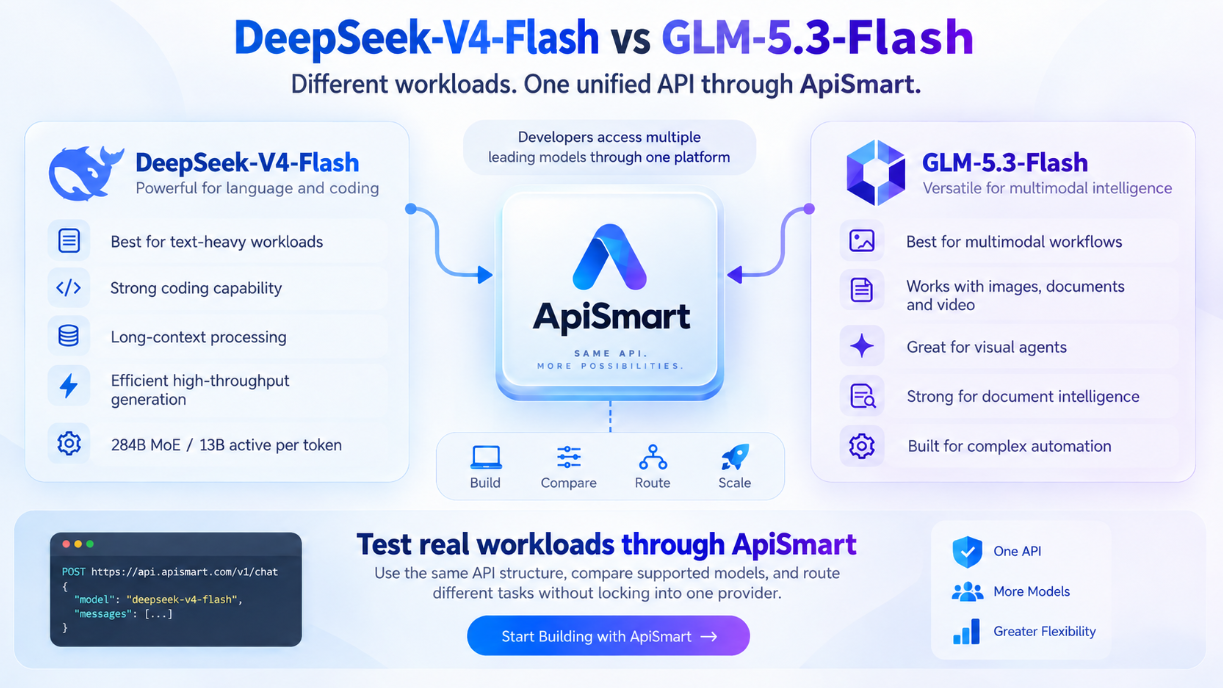
DeepSeek-V4-Flash and GLM-5.3-Flash are built for different kinds of workloads .
DeepSeek-V4-Flash is a natural starting point for text-heavy workloads that prioritize coding, long context, and efficient generation , coding capability and long-context processing. Its 284B MoE architecture activates only 13B parameters per token, giving it an attractive profile for high-throughput workloads.
GLM-5.3-Flash fits better when images, documents, video, or visual feedback are part of the workflow. Its multimodal design makes it a stronger candidate for visual development agents, document intelligence and complex automation.
The final decision should come from testing real workloads rather than relying on a single benchmark table.Through ApiSmart, developers can test supported models with the same API structure, compare them on real workloads, and route different tasks without tying the application to one provider.
Frequently Asked Questions
Is DeepSeek-V4-Flash better than GLM-5.3-Flash?
Neither model is universally better. DeepSeek-V4-Flash is well suited to efficient text and coding workloads, while GLM-5.3-Flash is more appropriate for multimodal and visual-agent applications.
Do both models support million-token contexts?
Their published specifications describe context windows around one million tokens. Hosted API limits may differ, so developers should verify the current limit for the selected endpoint.
Does DeepSeek-V4-Flash support images?
The standard DeepSeek-V4-Flash model is primarily text-based. Applications requiring image understanding should use an appropriate multimodal model.
Can GLM-5.3-Flash analyze screenshots?
Its multimodal capabilities make it suitable for screenshot analysis and visual-in-the-loop development, subject to the input formats supported by the API endpoint.
Are the models open source?
Both publish open weights under the MIT License. Developers should still review the relevant repositories and license files before redistribution or commercial deployment.
Can the models be self-hosted?
Yes, but their full parameter sizes require substantial memory and inference infrastructure. API access is usually easier for evaluation and workloads with variable traffic.
Can I access both models through one ApiSmart API key?
When both models are available in the ApiSmart catalog, they can be accessed through the same unified authentication and compatible API structure. Check the current model list for availability and exact model IDs.
Which model is better for coding?
DeepSeek-V4-Flash is a strong option for text-based code generation and repository processing. GLM-5.3-Flash may be preferable when coding tasks also require interpreting screenshots or rendered interfaces.