


Qwen3.7 Max Architecture Explained: Agent Workflows, 1M Context, and Kimi K3 Comparison
 2026-10-07
 1341 Reads
Alibaba describes the model as a foundation for long-running agents rather than a conventional text assistant. Its strongest design priorities are coding, tool use, workflow automation, extended reasoning, and the ability to keep working without losing track of the original objective.
That positioning matters. Most production AI failures do not happen because a model cannot answer a single question. They happen halfway through a task, when the model forgets an earlier requirement, repeats an unsuccessful action, misuses a tool, or stops before the requested deliverable is complete.
Qwen3.7-Max is designed around that problem.
What Is Qwen3.7-Max?
Qwen3.7-Max is Alibaba Cloud’s proprietary flagship model for agent-based applications. It was announced in May 2026 as a model capable of handling software engineering, office automation, multi-agent coordination and autonomous execution across long task sequences.
The model supports both thinking and non-thinking operation. Developers can use the faster mode for straightforward requests and enable deeper reasoning when a task requires planning, validation or several dependent steps.
Alibaba also provides access through multiple API protocols and agent frameworks. The model can therefore be connected to coding assistants, MCP tools, internal business systems and custom automation environments without forcing teams to rebuild an entire application around one vendor-specific interface.
What Does “Qwen3.7 Max Architecture” Actually Mean?
Alibaba has not published a complete technical specification for Qwen3.7-Max. Its total parameter count, number of layers, active parameters and internal expert-routing configuration have not been publicly disclosed.
Claims that assign the model a specific trillion-parameter figure or a detailed Mixture-of-Experts layout should therefore be treated carefully unless Alibaba releases a formal technical report.
What has been disclosed is the model’s operational architecture: how it reasons across long tasks, works with external tools and maintains continuity between successive actions.
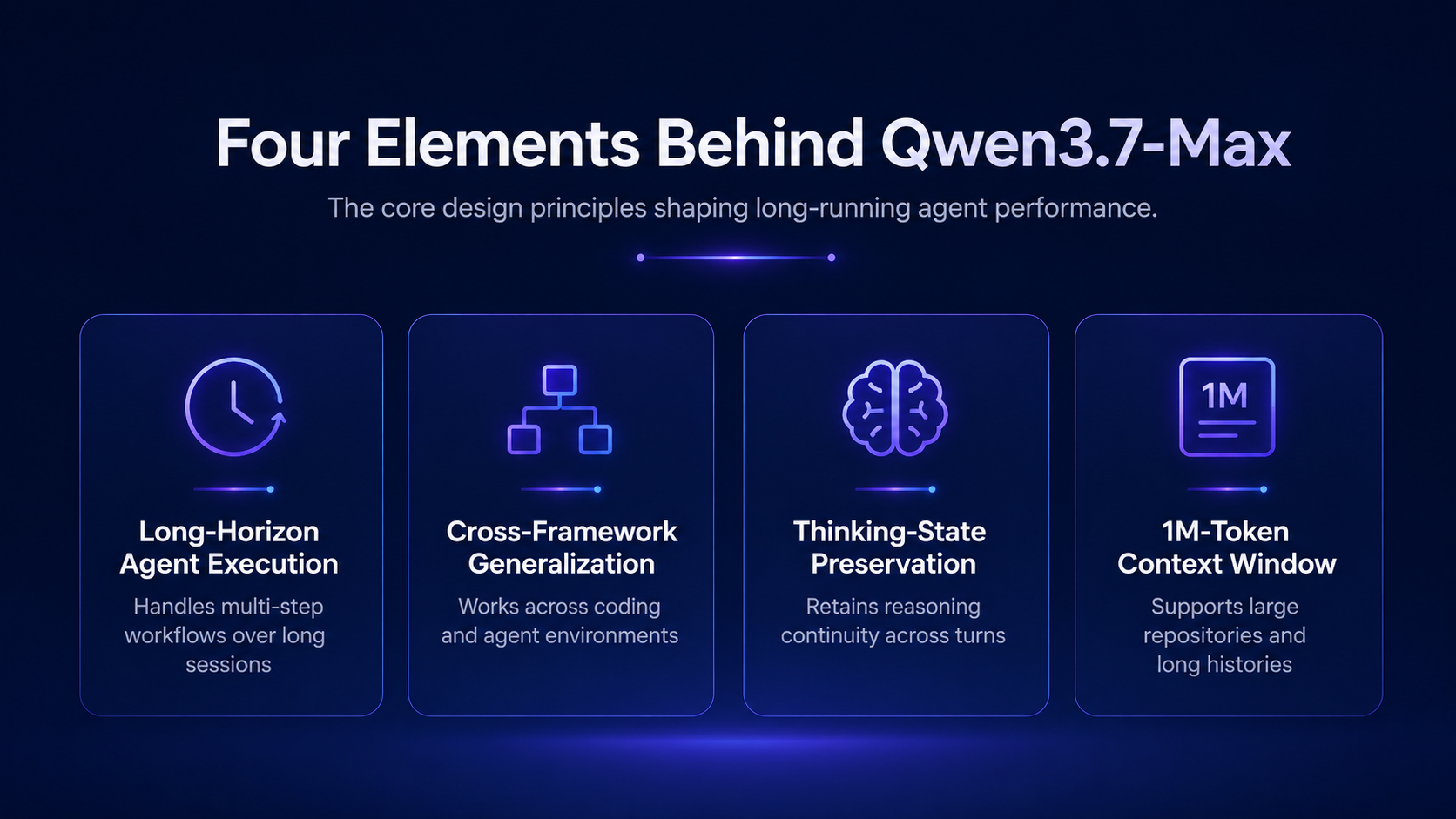
Four elements define that design.
1. Long-Horizon Agent Execution
Qwen3.7-Max is intended to remain productive across hundreds or thousands of steps.
This is different from simply supporting a long prompt. A large context window allows a model to receive more information, but it does not guarantee that the model can use that information consistently over a long workflow.
An effective long-horizon agent must repeatedly:
- inspect its current environment;
- decide which action to take;
- call an appropriate tool;
- evaluate the result;
- correct unsuccessful attempts;
- retain important earlier decisions;
- continue until the final objective is complete.
Alibaba demonstrated this capability through an autonomous kernel-optimization task that ran for approximately 35 hours. During the test, Qwen3.7-Max completed 1,158 tool calls and 432 kernel evaluations while writing, compiling, profiling and revising its own work.
The final implementation reportedly achieved a 10-times geometric mean speed improvement over the reference implementation. More important than the final number was the execution pattern: the model continued finding useful improvements after more than 30 hours instead of entering an unproductive loop or abandoning the task.
2. Cross-Framework Generalization
Agent models are often evaluated inside one carefully optimized tool environment. Strong results in that environment do not always transfer to another coding assistant or automation framework.
Qwen3.7-Max was designed to work across several agent harnesses rather than being tied to a single interface. Alibaba reports testing it with Qwen Code, OpenClaw, coding agents and custom tool-use systems.
This makes cross-framework performance an important part of the model’s value. A company may use one tool for code generation, another for browser automation and a third for internal document processing. The underlying model must interpret different tool schemas and response formats without requiring separate fine-tuning for every environment.
For developers, this reduces the risk of selecting a capable model that performs well only inside the provider’s own demonstration platform.
3. Thinking-State Preservation
Qwen3.7-Max supports a feature called preserve_thinking.
When enabled, reasoning information from earlier turns can be retained in the conversation history. This can be useful for agent workflows where the model needs to remember why it selected a particular approach, which hypotheses were rejected and what remains unresolved.
Consider a coding agent that has already:
- inspected a repository;
- identified three possible causes of a bug;
- tested two of them;
- modified several files;
- discovered a failed assumption.
If the model receives only the latest tool output, it may repeat earlier work or make a change that conflicts with its previous decisions. Preserving relevant reasoning state can provide greater continuity across the workflow.
The feature should still be used selectively. Retaining every intermediate token can increase context consumption and may preserve outdated assumptions. Production systems should combine reasoning continuity with context summarization, state storage and clear task checkpoints.
4. A 1M-Token Context Window
Current Alibaba Cloud documentation lists Qwen3.7-Max with support for requests of up to one million input tokens.
A context window of this size can accommodate large repositories, extensive document collections, long conversation histories and multi-stage agent logs. It is particularly relevant for:
- repository-wide code analysis;
- contract and policy review;
- financial document processing;
- long research workflows;
- multi-document retrieval;
- persistent agent sessions;
- large tool-result histories.
A one-million-token limit should not be interpreted as a reason to send every available file with every request. Larger prompts increase processing cost and can make relevant information harder to isolate.
A more reliable production design usually combines the long context window with retrieval, structured memory, caching and periodic context compression. The larger window then acts as additional capacity rather than a replacement for context management.
Thinking and Non-Thinking Modes
Qwen3.7-Max supports both thinking and non-thinking modes.
Non-thinking mode is suitable for tasks such as:
- classification;
- extraction;
- rewriting;
- short summaries;
- routine customer responses;
- structured data generation.
Thinking mode is more appropriate when the request involves:
- multi-step planning;
- difficult coding problems;
- mathematical reasoning;
- tool selection;
- debugging;
- conflicting constraints;
- validation of intermediate results.
Using the deepest reasoning mode for every request may increase latency and output-token usage without producing a meaningful improvement. A practical routing system should classify each request and select the appropriate mode according to complexity, latency requirements and budget.
Where Qwen3.7-Max Is Most Useful
Coding Agents
Qwen3.7-Max is designed to move beyond isolated code snippets. It can inspect existing projects, edit multiple files, run commands, diagnose failures and continue refining a solution after receiving execution feedback.
This makes it relevant for:
- repository-level refactoring;
- frontend development;
- test generation;
- dependency migration;
- debugging;
- performance optimization;
- internal developer assistants.
Its value is highest when the model has access to a controlled execution environment and receives clear feedback from tests, compilers or evaluation scripts.
Office and Document Automation
The model can also operate as a tool-using productivity assistant. Alibaba demonstrates workflows involving spreadsheets, documents, formatting requirements and multi-step office tasks.
Potential uses include:
- generating structured reports;
- reviewing document collections;
- formatting long documents;
- building spreadsheet models;
- extracting information from business files;
- preparing first drafts of presentations;
- coordinating several productivity tools.
These workflows still require validation. A model may produce a polished document that contains a calculation or formatting error. Automated checks and human review remain necessary for financial, legal and operational materials.
Enterprise Agents
Qwen3.7-Max can serve as the reasoning layer behind an enterprise agent that connects with internal tools.
For example, an agent could retrieve records from a knowledge base, query a business system, update a document, generate a summary and request approval before completing a sensitive action.
The model alone does not provide access control, audit logs or data governance. Those functions must be implemented in the surrounding application. Model capability and system security should be evaluated separately.
Qwen3.7-Max vs Kimi K3
Qwen3.7-Max and Kimi K3 both target advanced coding, reasoning and agent workflows, but their public specifications are very different.
Moonshot AI provides considerably more architectural detail for Kimi K3. The company states that the model contains 2.8 trillion parameters and combines Kimi Delta Attention, Attention Residuals and a sparse Mixture-of-Experts structure. Sixteen of 896 experts are activated during processing.
Kimi K3 also offers native vision capabilities and a one-million-token context window. This makes it attractive for workflows that combine code, screenshots, documents and visual reasoning.
Qwen3.7-Max takes a different approach in its public messaging. Alibaba focuses less on internal parameter counts and more on execution behaviour: long agent sessions, framework compatibility, tool use, office automation and consistent performance across different agent environments.
The better model therefore depends on the application.
Choose Qwen3.7-Max when the priority is:
- extended autonomous execution;
- cross-framework agent deployment;
- repeated tool use;
- coding and office automation;
- controllable thinking modes;
- access through Alibaba Cloud infrastructure.
Evaluate Kimi K3 when the priority is:
- native image understanding;
- publicly documented architecture;
- open model access;
- large-context coding;
- visual knowledge work;
- architecture-level customization or research.
Parameter count alone should not determine the decision. A larger model can still perform worse in a specific agent harness if its tool calling, post-training, context management or inference configuration is less suitable for that workload.
What About Qwen3.8-Max-Preview?
Qwen3.8-Max-Preview is a newer preview model available through Alibaba Cloud’s Model Studio Token Plan.
Official material describes it as the latest and most capable model in the Qwen family and highlights full-stack development, data analysis, office workflows and vision understanding.
However, the current public preview documentation does not provide a complete parameter count, expert configuration, active-parameter figure or full architecture description.
For that reason, statements describing Qwen3.8-Max-Preview as a confirmed 2.4-trillion-parameter MoE model should not be presented as established specifications without an official technical release.
The preview status also matters for production use. Alibaba notes that its capabilities may change during the preview period and that the preview model may later be removed or replaced by a production version. Teams testing it should avoid hard-coding assumptions about model behaviour, identifiers or availability.
How to Evaluate Qwen3.7-Max for Production
Public benchmarks provide a useful starting point, but they cannot reproduce every company’s tool configuration, prompts, data and latency requirements.
A production evaluation should use real internal tasks.
Build a Representative Test Set
Include examples covering:
- easy and difficult requests;
- short and long contexts;
- successful and failing tool calls;
- ambiguous instructions;
- multilingual inputs;
- repository-scale coding;
- repeated revision cycles.
Measure More Than Answer Quality
Record:
- task completion rate;
- tool-call accuracy;
- time to completion;
- input and output tokens;
- number of retries;
- context growth;
- unsupported claims;
- human correction time;
- cost per completed task.
For agents, cost per request is less useful than cost per successfully completed workflow. A cheaper request does not save money when the agent needs several retries or leaves the work unfinished.
Test Long Sessions
A model intended for long-horizon agents should be tested over long sessions.
Check whether it:
- repeats previous actions;
- forgets constraints;
- changes strategy without explanation;
- stops too early;
- accumulates unnecessary context;
- recovers after tool failures;
- validates its final output.
Keep a Fallback Model
No single model performs best on every workload. Production systems can route coding, visual analysis, simple extraction and complex reasoning to different models.
A fallback route also protects the application against provider outages, rate limits and model-version changes.
Accessing Qwen Models Through a Unified API
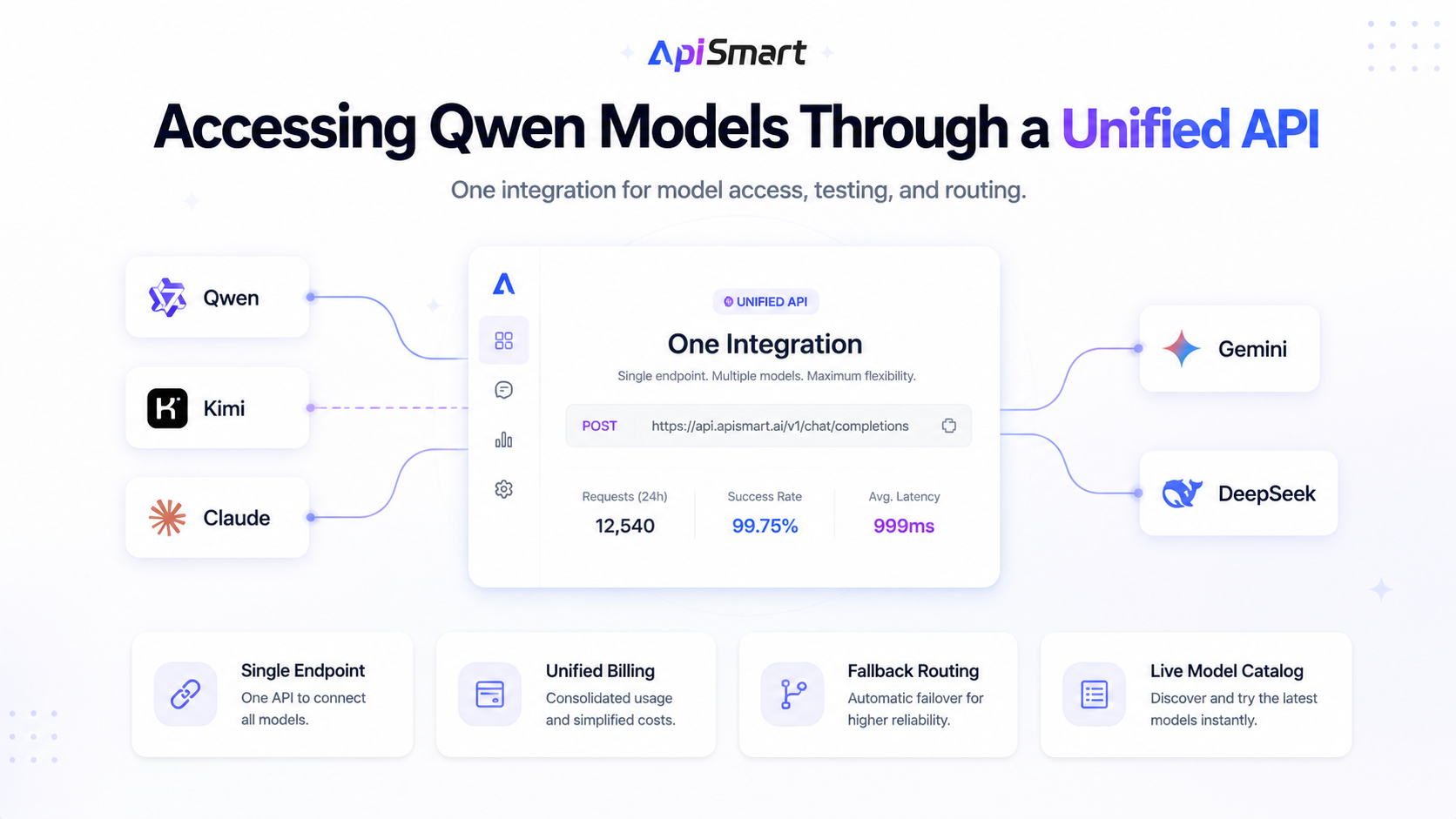 Managing separate integrations for every model provider creates ongoing operational work. Teams must maintain different credentials, request formats, billing systems, error responses and model identifiers.
ApiSmart provides a unified API layer for supported AI models, allowing developers to manage model access through one integration. This makes it easier to test multiple models, compare output quality and introduce fallback routing without rebuilding the application for every provider.
Before selecting a production model, check the live ApiSmart model catalog for current availability, supported capabilities and pricing.
Final Assessment
Qwen3.7-Max is not notable because of a publicly advertised parameter count. Its value lies in the way it is designed to operate: extended reasoning, persistent tool use, cross-framework deployment and long-running agent workflows.
Kimi K3 offers greater architectural transparency, native vision and a publicly confirmed 2.8-trillion-parameter design. Qwen3.8-Max-Preview introduces a newer multimodal direction, but its complete architecture has not yet been officially documented.
For developers, the practical decision should come from workload testing rather than launch claims. Measure how reliably each model completes the full task, how often it needs intervention and how much each successful workflow costs.
The strongest model is not always the largest one. It is the one that finishes the work.